Most startups do not die in one public event.
They drift.
The outside world usually sees the final chapter. The team lives through the early chapters in silence. Weekly planning gets louder. Confidence in priorities gets weaker. Release velocity looks active, yet customer value feels harder to explain.
That pattern has a name.
It is scope drift.
“The company does not break in one sprint. It weakens in small decisions that no one challenges.”
The Slow Slide Nobody Announces
In the beginning, expansion feels like progress.
A new customer asks for an enterprise workflow. A partner asks for a new integration. A founder sees a new market opportunity and wants to test it quickly. None of these decisions are irrational by themselves.
The problem starts when every request becomes active scope.
When product surface grows faster than strategic clarity, execution starts splitting into parallel stories. Teams then spend more energy coordinating context than delivering compounding value.
This is why many startups feel busy while moving in circles.
What Scope Drift Actually Is
Scope drift appears when product surface area rises faster than system coherence.
System coherence means three things stay aligned:
- What problem the product exists to solve
- Which user behavior defines success
- Which architecture decisions protect long term speed
When any one of these weakens, drift risk rises. When all three weaken at once, entropy becomes the default operating mode.
Entropy Snapshot
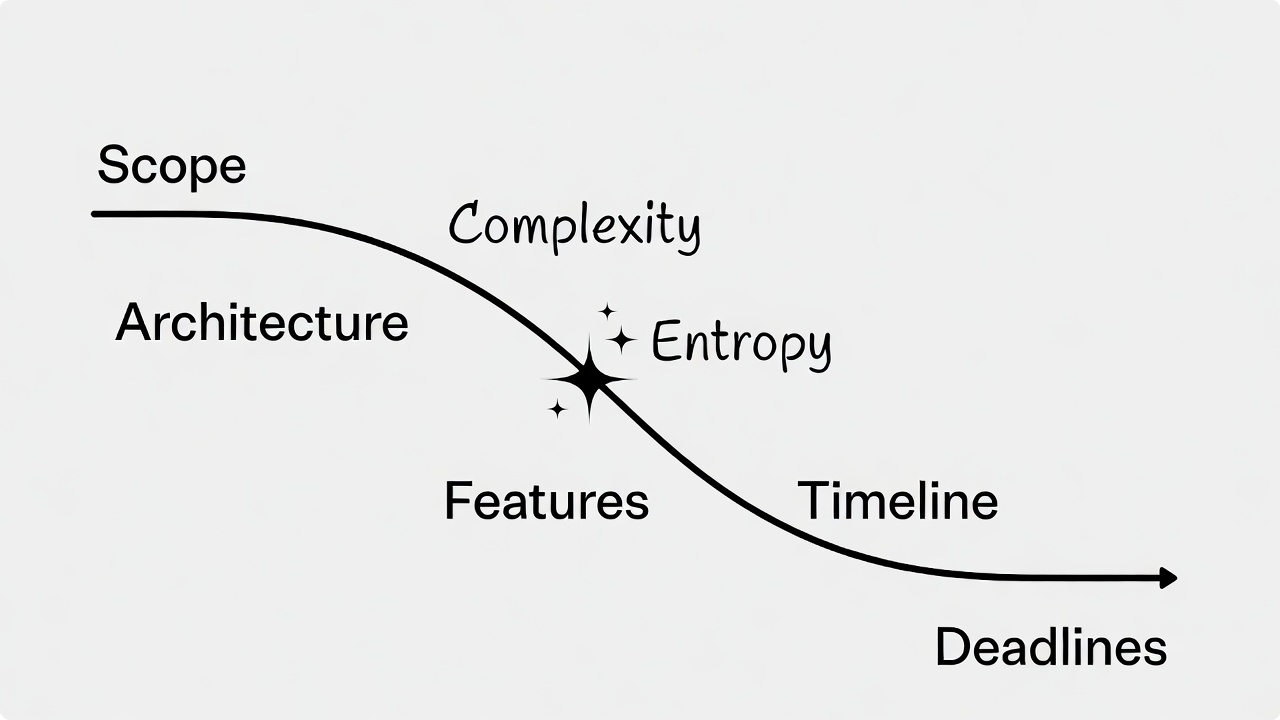
Visual map of startup entropy. Expansion can look healthy at first, then silently outrun clarity and governance.
Interactive Drift Simulator
Use this model to test how expansion pressure, execution discipline, and AI build acceleration change drift risk over time.
Scope Drift Risk Simulator
Adjust the controls to compare product surface growth against strategic clarity over five phases.
Current drift risk Moderate The system needs tighter scope control before complexity compounds.
If the product surface line rises faster than the clarity line, the distance between both lines is the risk gap your leadership team must close.
Case Drift Explorer
Select a company to inspect how expansion intensity compared with strategic coherence.
Current case
Quibi
Expansion intensity
Strategic coherence
Case Studies That Show The Pattern
The same structure appears across very different companies and eras. Sector, product type, and funding profile change. Drift mechanics stay surprisingly consistent.
| Company | Core work | Expansion strain | Website |
|---|---|---|---|
| Quibi | Mobile short form streaming | Too many strategic assumptions in one launch | Coverage |
| Webvan | Online grocery logistics | Infrastructure scale before repeatable economics | Coverage |
| Yahoo | Search and portal stack | Product surface spread beyond one governing core | Website |
| WeWork | Flexible office platform | Adjacent expansion before governance maturity | Website |
| Evernote | Knowledge capture and recall | Feature expansion diluted core narrative | Website |
| Myspace | Social discovery and creator traffic | Experience complexity outran platform clarity | Website |
| Groupon | Local demand marketplace | Category expansion diluted original loop quality | Website |
“What looks like fast growth from outside can be silent entropy from inside.”
Quibi
Quibi entered the market with very high visibility, major capital backing, and premium production ambition. On launch day the story looked strong. The product looked polished. The press attention was large. The team appeared prepared.
The deeper issue was strategic density. Multiple assumptions were coupled together from day one. Users had to adopt mobile first premium short episodes. Retention had to sustain a paid model. Content economics had to justify studio grade production very early. Each assumption depended on the others.
When early behavior did not stabilize around those assumptions, there was no simple resilient loop to protect the system. The model did not have a low complexity fallback mode.
The product did not fail because ambition existed. It failed because strategic load was stacked before market behavior became stable.
Drift lesson: ambition is not the danger. Simultaneous strategic uncertainty is.
References:
Webvan
Webvan pursued a bold model that required heavy operational coordination across warehousing, routing, inventory, and last mile delivery. This was a difficult system to scale even with modern tooling. In its era, execution risk was even higher.
The company expanded physical infrastructure and market footprint before proving durable economics in a narrow controlled region. Expansion speed became the signal of confidence, but confidence and repeatability are not the same.
Once the footprint grew, the cost of reversing mistakes also grew. This is scope drift in physical form. System complexity expanded before system repeatability.
Drift lesson: repeatability must come before expansion, not after.
References:
Yahoo
Yahoo stayed relevant across many internet categories for years and shipped meaningful products at scale. This was not a weak execution organization. It was a broad and capable one.
The challenge was strategic concentration. Search, media, communications, communities, commerce, and adjacent services formed a wide portfolio that became difficult to govern under one sharp core doctrine.
While Yahoo widened, focused competitors deepened around fewer loops with stronger infrastructure leverage. Breadth produced reach. Focus produced compounding defensibility.
The issue was never experimentation itself. The issue was weak unification of experimentation into one operating center.
Drift lesson: a portfolio is not a strategy unless one core engine governs the portfolio.
References:
WeWork
WeWork began with a clear value narrative around flexible workspace and community identity. The growth story then accelerated into a larger platform narrative with several adjacent initiatives.
As surface area grew, governance maturity and operating control needed to mature at the same speed. That synchronization did not fully happen. External momentum and valuation attention masked internal coherence stress for longer than expected.
This is a common drift signature in scale narratives. From outside, the company appears bigger each quarter. From inside, coherence gets harder each month.
Drift lesson: valuation speed can hide structural fragility.
References:
Evernote
Evernote earned loyalty through simple clarity. Capture ideas quickly. Organize them safely. Retrieve them anywhere. That loop gave the product a durable identity.
As the product surface expanded, additional layers and positioning shifts made the value story less direct for some user segments. Utility stayed. Narrative sharpness softened.
This case is important because drift does not always end in collapse. Many companies survive drift but lose edge through gradual dilution.
Drift lesson: survival is not enough. Strategic sharpness must also be protected.
References:
Myspace
Myspace had real cultural gravity and strong early network momentum. It was not a minor platform. It shaped online behavior for a generation of users and creators.
As the platform accumulated heavy customization, layered modules, media noise, and uneven experience patterns, usability and performance became harder to govern at scale.
A cleaner competitor model with tighter interface discipline and lower cognitive load then gained advantage over time.
Drift lesson: product freedom without experience governance eventually reduces user confidence.
References:
Groupon
Groupon scaled quickly with a clear local deals loop that was easy to explain to both users and merchants. The initial model had strong behavioral clarity.
As category scope widened, identity coherence became harder to preserve. Expansion can create optionality, but only when it reinforces the original mechanism that created trust.
The brand remained known. The operating profile narrowed as the original simplicity weakened.
Drift lesson: growth channels are useful only when they reinforce the core loop.
References:
What Teams Usually Say Before Drift Accelerates
These lines sound normal in weekly meetings. In combination, they are early warning signals.
“Let us ship now and clean architecture next quarter.”
“This feature is for one customer only, so impact is limited.”
“We can support both directions for now and decide later.”
“Everything is priority because every deal matters.”
“We are adding options, not changing strategy.”
Each sentence is reasonable in isolation. Together they create strategic fog.
Drift Timeline Visual
| Phase | What leadership feels | What the system is doing | Risk trend |
|---|---|---|---|
| Early expansion | Energy and optimism | Scope enters faster than scope exits | Low but rising |
| Mid expansion | Busyness and context overload | Ownership becomes fragmented | Moderate |
| Late expansion | Slower decisions and rework | Architecture and roadmap diverge | High |
| Pre crisis | Firefighting and blame cycles | System coherence is weak | Critical |
This is why drift feels invisible at first. Emotional signals lag structural signals.
Scope Drift Scorecard
Use this scorecard monthly.
| Signal | Early evidence | Late evidence | Owner |
|---|---|---|---|
| Product boundary clarity | Teams can explain what is out of scope | Teams redefine scope in each meeting | Founder and product lead |
| Architecture integrity | Decision records are current | Major decisions are reversible by accident | Engineering lead |
| Metric coherence | One primary system metric guides tradeoffs | Different teams optimize different outcomes | Leadership |
| Release quality | Fewer but clearer releases | More releases with lower user impact | Product and engineering |
| Decision speed | Tradeoffs are explicit and fast | Tradeoffs are political and delayed | Leadership |
If three or more rows are in late evidence mode, drift is active and compounding.
Why Even Strong Teams Drift
Drift is not proof of weak talent. It is usually proof of strong pressure plus weak constraints.
Growth Pressure
Once traction appears, adjacent expansion is often rewarded before core stability is proven.
Build Speed Inflation
Modern stacks and AI assistance make feature generation easy. But strategic evaluation remains slow, social, and difficult.
Local Optimization
Every function can make rational choices for local goals while the full system degrades.
Delayed Consequences
The cost of drift appears later than the decision that caused it. That delay weakens accountability.
Identity Drift
When a company serves too many narratives at once, teams lose confidence in what the company actually is.
A Practical Drift Control System For Founders
You cannot remove entropy. You can control its rate.
- Write a product boundary statement. Define what the product is not with the same clarity as what it is.
- Run a monthly scope in and scope out review. New scope must be matched by removal or consolidation.
- Use architecture decision records. Strategic technical choices need written reasoning and ownership.
- Allocate simplification capacity. Every execution cycle should reserve effort for debt removal and system cleanup.
- Anchor tradeoffs to one primary system metric. A single metric exposes optional work quickly.
- Keep founder level coherence ownership. Product direction, technical direction, and operating rhythm must remain one conversation.
Ninety Day Reset Plan
If drift is already visible, run a focused reset.
Days 1 to 30
Freeze net new expansion work unless directly tied to core value delivery. Publish the product boundary statement. Audit all active initiatives against one primary system metric.
Days 31 to 60
Consolidate overlapping initiatives. Remove low leverage scope. Update architecture decision records for critical systems that drive release speed.
Days 61 to 90
Rebuild planning cadence around measurable outcomes. Move from feature commitments to outcome commitments. Track weekly confidence in strategy clarity across functions.
Weekly Leadership Template
Use this in your standing leadership meeting.
- Which new work entered scope this week
- Which work exited scope this week
- Which releases moved the primary system metric
- Which releases increased complexity without measurable value
- Which architecture decisions need formal documentation
- Which complexity source will be removed next week
If answers are slow or inconsistent, drift risk is rising.
The Real Competitor Is Often Internal Entropy
Founders often look outside first. Competitors, market shifts, capital conditions, platform changes.
Many startups lose momentum before external pressure becomes decisive.
They lose because internal complexity grows faster than shared clarity.
The winners are not always the teams that ship the most.
They are often the teams that defend coherence while they scale.